
The Creation Of A Spit6

Home Page: Wayne Tate

Spencer, NC, USA
| Total Posts: 50 | Latest Post: 2023-10-05 |
| Table of Contents | RSS Feed |
Lining the darn panel clips up is a bitch. Really need a lift to get the bottom ones lined up, but laying on the floor will work, just the getting up part. LOL
I used a 3/16 inch spring pin cut to size for the door handle pin, used fine needle nose to hold it in the hole, much easier.
I still had the original plastic covers for the inside of the door.
Don't know if I'm up to messing with the tunnel parts this afternoon, have to get the sewing machine out for the brake and knee pad ones.
I worked on the tunnel brace a few days ago, that will tear your hands up pulling around the foot. Not as hard as I though once you figure out the size of the padding needed and cutting it on the slant before covering in thin headliner foam.
Next day.
Worked some more on the interior.
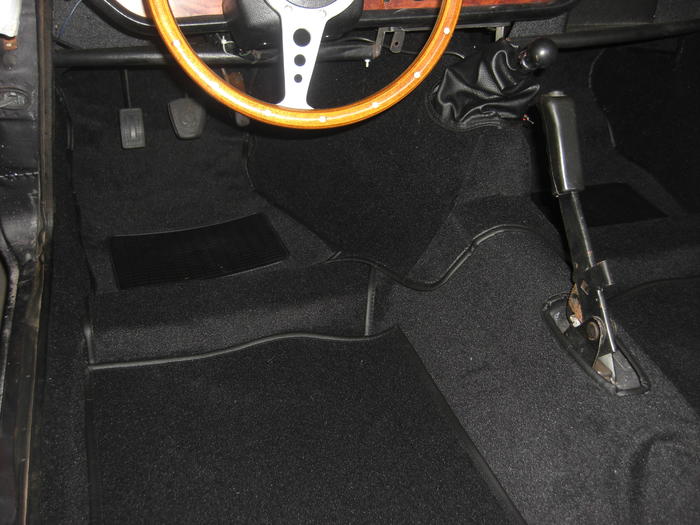
Got the tunnel in with not too much hassle. For the first timer, put the top in first, then lift it from side to side and pull the carpet into place where you cut the holes. Will install top bolts in when I put the radio plate and radio in. Didn't have to jack up the dash on this one.
Did the most awkward job of all, putting the snaps on the carpet to secure it from moving every time you get in. Getting the female part into the carpet and riveted over was bad enough, but getting the top ones in the right spot was a back breaker for 79 year old. LOL did try to mark it with chalk but a pointer into the rivet proved to be best for a precise placement. Now as far as getting the top hat of the female in place, be prepared to shave that part of the back of the carpet in that area.
Was using a trouble light on one side and LED De Walt on the other, the trouble light did a little melting of the rubber pad on the driver side when I went to get washers for the male snap. You will want to put the lamp up off the floor, especially if you have insulation, so just a heads up on that. Have the Triumph mats for the foot well, so for me not a major problem, others maybe so. .
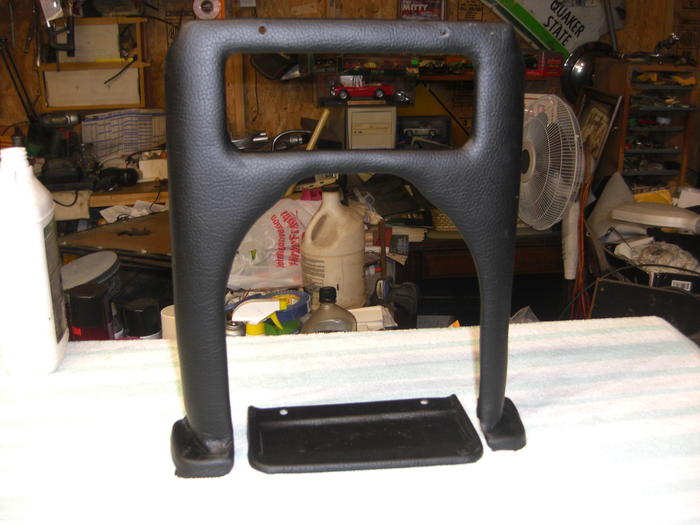
CIMG0589
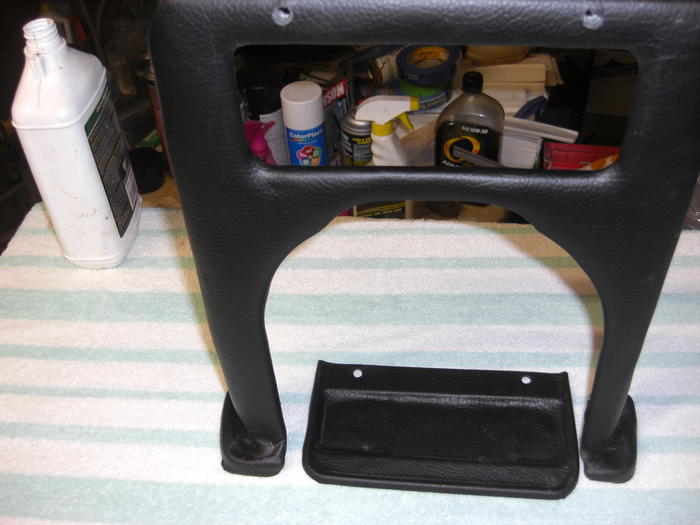
CIMG0590
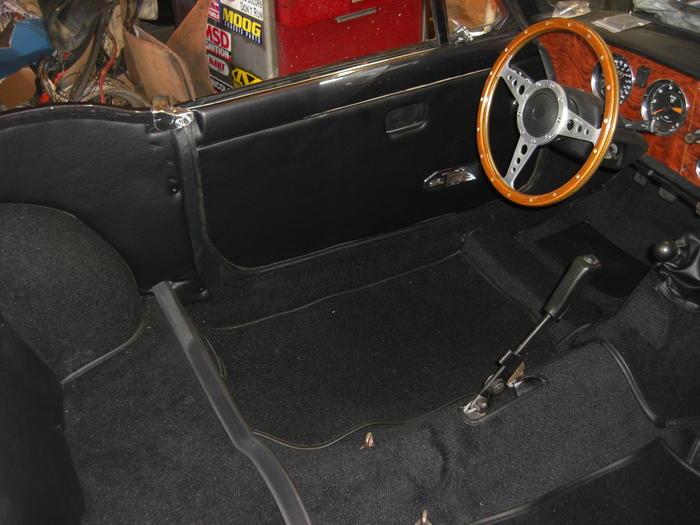
CIMG0587

CIMG0588

It's not plush but does the job and although not a perfect fit, with some effort you can make it fit as good as the original.
The section under the foot pedals is going to require a bit of trim as is the other side of the foot well.
Still putting all the panels together, but was a warm day at the end of December, so the glue was setting quick. Will finish that part up tomorrow and post.
Finished up today and the amount of trim was a lot. 4 inches on the passenger side and 3 inches or more on the driver side.
Shove it up to the top in a curled position and mark it with chalk where you need to cut. Make the first cut a bit short to make sure you don't take off too much.
The kit does not come with a carpet cover, where the hood bracket is,,so grab some spare carpet somewhere to use there and in places the seams just don;t go together. .A small sliver of carpet glued in that area will make it disappear.
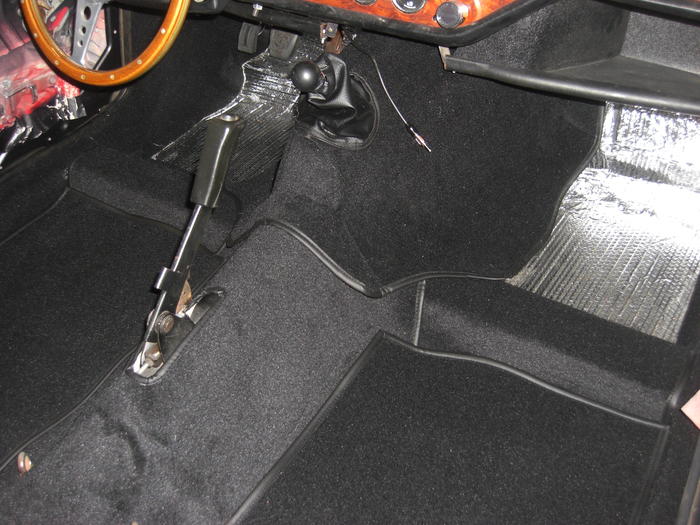
CIMG0582

CIMG0581
CIMG0584

CIMG0583
No comments have been posted yet...
Want to leave a comment or ask the owner a question?
Sign in or register a new account — it's free
After getting all the initial brackets in place you will find one or the other clamps or brackets have interference with each other.
One of the first things was getting the choke and accelerator to return to the stop with just a little positive move, so added a "L" bracket to the cable bracket and added two of the return springs from the SU carbs, not great tension but just right.
Here is a problem I didn't know I had, the cable pull would not give me full throttle, the cable end was hitting the long screw bracket, so had to cut it off very carefully, so as not to cut the strands in the cable. Cut about 1/2 inch off and was able to get almost there. There was no further adjustment out there, as I tried a couple different size pull rods, just not enough movement.
I went inside to find the pedal was all the way to the floor and only 3/4 pull.
Checked the spacing of the pedal with one from another car and mine was spread more than a couple of inches wider. Not easy to bend, but grabbed a pair of gloves and got serious about closing the gap. Got the accelerator pedal almost even with the other pedals and now have a full turn on the butterfly. this would not have been possible even at that if I had not cut the brass threaded fitting at the bracket.
These are the MK1 carbs so don't have the vacuum port between the rear of the carb and the manifold, but the gaskets did have the cut out. The regular gasket will not seal that area and you will have a vacuum leak for sure. To solve that issue, I found the standard front one will work if tuned correctly to cover the hole. The ones I took off had that gasket on the back of the insulator and I could not for the life of me get the idle down under 1000 and now I know why.
If you are having that issue, only way to check is take them off.
The early bolt holes for the air filter are 5/16 24 where the later ones 516 18, both are 2 1/2 inch, you could get away with 2 and 1/4 but the front one has to be the longer one.
If you are going to do this, be prepared to re engineer the whole thing. LOL
Wayne

Just painted the filter metallic to go with the valve cover. Still have to add the hoses to the front for cold air.
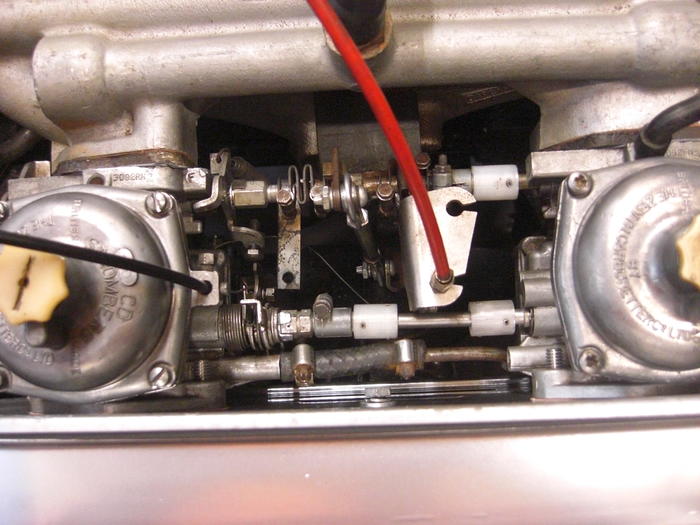
Things get tight here, still used the plastic couples that Brian made, couldn't do it in one place. You can see the springs off the "L" bracket.

You can see a good size gap where the standard gasket doesn't cover.
No comments have been posted yet...
Want to leave a comment or ask the owner a question?
Sign in or register a new account — it's free
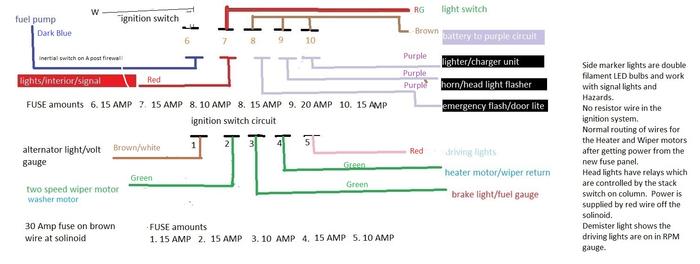
The fuse values are a little low but they are for mostly run on a one fuse circuit instead of multi functions off the old fuse panel.
Most everything in your car runs off the brown wires and there is a cluster under the dash coming from the one off the solenoid. I fused that one with a inline fuse of 35 AMP's. Nothing I'm running should require more than that.
If you run a big stereo you need to come off the battery with more than this
I did a little write up for a member and thought I would add it here, gives a little bit more detail of what I did.
Each circuit starts out being run by the Brown or the White wire.
White being controlled by the ignition switch. So mostly I added a
six inch pigtail at the box for both wires and added 3 junctions off
that wire for the brown and 4 off the white, maybe 5 as I put the
electric fuel pump on that.
I placed a 35 AMP fuse on the Brown wire off the solenoid that comes
into cabin, as it's a major supply for the Ignition switch (white
circuit.) and Red circuit (lights) as it goes right to the back of the
light switch and the red/green did go to a fuse on the old box to
control that circuit. So that was added to the new box.
Now you have to check the wires for each function and divide them up on
the output. The wiper motor does have two green wires to supply power
and one is the return or stop switch, I didn't put them on the same
circuit.
On my box, it was going to be a little difficult to open it behind the
clutch master, so a couple of washers under the bracket moved it out of
the way.
Everything was soldered and I suppose it could be done in the car, but
I had the harness out and got rid of all the buzzer wires.
Oh, my headlights are on there own circuit off the solenoid, you can
buy that harness with relays and fuse included. Much easier. All
grounds at the front were installed on a strip bolted to the frame.
Just for adding to your thoughts, I installed LED's in the side markers
with double filaments and they work as signal and hazard plus running
lights.
Got the box off Amazon and all the male and female spade connectors,
wiring harness for lights and relays.
Hope that helps,
Wiring for Spit6
Want to leave a comment or ask the owner a question?
Sign in or register a new account — it's free
I converted a '78 Spitfire harness to do most of the normal functions needed and installed new where needed.
Chasing a no head lights problem turned out to be operator error. In my efforts to be neat with the new front harness with the relays. I pulled the wires and mounted the relays on the top side of the inner fender. Then tied off the wires in plastic wrap and tie wraps to hold every thing in place.
Looked great a few weeks ago when I was doing it.
The harness was with the double relays was pulled away from the sockets by just enough up at the top of the fender, unless you stepped inside by the radiator you didn't see it. Took a hour or so checking all the wires to see where I was losing power. That was the easy one.
The interior and parking lights lets some smoke out today and had worked perfect a few days ago when buttoning up the dash. I had used some 3 Amp fuses and they blew quick enough, wondering what I did wrong, as I had a direct short somewhere. Took the center dash out and couldn't see any thing obvious. Did notice the bright dim light switch was moving, will put a small washer in the flat area to keep it from spinning, so took it out and as luck would have it, noticed the lower spade on the switch was bare. Looked at were the switch was ending up when turning and the fuel gauge housing was stopping it and also a nice burn spot. So that was luck to find it that quick, as it could have been anything on a new harness.
Plugged a empty insulated female plug on it and will keep it from turning. All is fine again.
Couple of other things will keep me busy for a afternoon. The ignition light on the speedometer is not coming on, put some power on the brown'yellow wire at the alternator and it lite up, so with a battery that problem will hopefully go away.
The high beam light also decided to not to work, I'll trace that down to where it connects to the blue/white wire, or it may not work as original with all the new lights having power supply from the solenoid, hate it, but will run a jumper from the plug in under the dash if I can' sort it out.
The hazard switch works fine with all the LED's, rear/front signal lights and all four side markers, very well lite up.
No comments have been posted yet...
Want to leave a comment or ask the owner a question?
Sign in or register a new account — it's free
First off, I did mine by taking the steering clamp off the lower bar because I had already taken the steering completely out in the restoration for cleaning, so I know there were not any parts in the column cover. As these bushings tend to break apart a good idea to at least remove the shafts locking bracket and rear side of the universal clamp on the steering rack and pull the whole thing out of the car. Good time to clean and add some light oil to the whole thing.
The old bushing at the top will be in bad shape looking at it, but I think why no one does this job is the fact the wear where the steering column goes is not a major wear area, so not real loose like the old ones where the horn would blow when you turned to go around a corner, so if it ain't broke don't fix it sort of thing.
The photos show what looks to be the position for the bushing
The new bushing has a rounded end and a squared off end, the rounded goes down the column. When you push the new one in, use some light weight oil on the inside and outside, it will stop on the outer ridge and you will think that is it. Nope, take a flat side of a 24 MM socket and tap it on down, making sure the left side grove in the bushing is lined up with the notch out of the column at 10 o'clock. The one on the bushing will close up but if yours switch column surround is like mine the grove to lock things in place is not wide enough to hit the plastic.
Now is the time to run the steering shafts in, don't forget the washer that goes between the column end cape and the clap. Kind of confusing where it goes, but best I can figure is the clamp goes up next to the end of the column. Gets a little tricky here, as the ignition switch lock needs to be paid attention too. You will need to turn the switch on to get the shafts in there, so disconnect the battery to save burning up you ignition. Once it's down in the locking area, get the wheels straight and turn the upper shaft until the lock works, leave it there and don't take it all the way in yet. Give the columns a good check to make sure the flat part of the lower shaft is lined up with the flat cutout of the top shaft before you install in the universal clamp on the lower serrated part and push a bolt through and nut on it. That sounded easy, but it's in the middle of the suspension tower, so spreading the clamp will help if you didn't do it getting it out. Working from the front of the tower will let you get the bolt in and a 1/4 inch drive with a short socket will tighten it up. If I can do it at 78 you younger guys and gals should have not problem.
Back to the top of the column. Put the locking clamp on the columns just enough to keep the flats together while you finish up the rest. Good time to unlock the switch to make sure all is in good order, set the steering wheel on and give it a couple of pulls and go back to neutral.
The steering shaft should be installed at 3 and 1/8 inches from the end of the metal outer column, now is the time to tighten down the locking flat bracket under the dash. Install the switch cluster with the tit going into the slot at 10 o'clock. Note the wires have to be pulled in a way as not to be in a bind. Tighten down the clamp screw, install the steering wheel, washer and nut. Cover with the casing and if you are lucky all will work.
This was my way and is correct for my situation, yours may differ.
Photos show a few things that need your attention.

With a socket the right size it will go level, get the 10 o'clock slot aligned.

Not the tab to align on the slot, be careful of the wires.

Steering knobs line up with the cancel part of the turn signal.

Angle only shows about 3 inch, but it was 3 1/8, yours may be different.
No comments have been posted yet...
Want to leave a comment or ask the owner a question?
Sign in or register a new account — it's free



No comments have been posted yet...
Want to leave a comment or ask the owner a question?
Sign in or register a new account — it's free